



This issue is dedicated to one of the most notorious startup career paths.
While I also like to talk about broader topics, I’ll also sometimes deep dive into very specific ones, shaped by my own experiences over the years.
In most companies, becoming a manager feels like the only available path for top performers.
It’s the default. But it doesn’t have to be.
I’ve shifted back and forth between individual contributor (IC) and manager roles my entire career, and I’ve learned something crucial:
Management isn’t for everyone. And that’s completely fine.
Society historically links management to power, status, and success.
And that’s still true in most traditional industries today.
From New York restaurants to tech startups, I carried the belief that “climbing the ladder” meant managing others.
When I first became a restaurant manager at 24, I thought I’d reached my professional peak.
So when I left the restaurant industry to work in tech, I naturally once again pushed myself into management at Zenly, thinking it was the obvious and only next step.
When I finally got promoted, I felt proud. Like it was the validation I’d been chasing.
But reality hit hard.
The setup was awkward. I had to keep executing as an IC while managing a small team. No onboarding. No ramp-up. Just go.
After a few months, it was clear: this wasn’t sustainable. I was burned out and miserable.
Looking back, it was a recipe for failure. I understand why I was asked to “keep the same pace” as we simply couldn’t afford to slow down.
But still, it was a mess. A necessary one, maybe. But a mess nonetheless.
Eventually, I stepped back into my IC role.
It never felt like a demotion to be honest. It was a relief. I was doing what I was best at. I regained confidence shipping new features head down.
And I finally had space to reflect on what I’d actually learned.
A few months later, I became Head of Design. But this time, I had more clarity.
I would still be hands-on but I would try to do my best instilling new ideas, be a little spark that inspires other team members, leading the way.
I would be a leader, not a manager.
That didn’t mean avoiding responsibility. I still had to grow the team and bring in new talent. And fast.
Get this: you’ve never hired anyone in your life and you’re told to hire “better designers than myself” to succeed.
There’s something deeply contrary and unnatural but it makes a lot of sense.
If you manage to bring in people you admire, you’ll level up too. It forces you out of your comfort zone—not just as a designer or engineer, but as a leader.
During hiring calls, I realized telling great ICs they’d “report to me” didn’t really work.
But when I framed it differently, saying I was one of the OG ICs, leading new efforts with a strong vision, it changed everything.
It removed the awkward hierarchy tension and created a sense of shared mission.
As David Hoang puts it in his—highly recommended—Proof of Concept newsletter:
To lead without direct authority is a sign that people are inspired by you.
At amo, the early-stage realities reinforced this insight.
With limited resources and huge ambitions, I had to lead AND execute alongside the team.
We hired individuals excited to build and collaborate, and while I’m convinced that titles do matter in a career, early stage is not the place for those inspiring to quick managerial titles.
Early-stage startups thrive when they stay flat and horizontal. Promoting managers too early adds bureaucracy, slows decisions, and kills momentum.
Duolingo’s design team is a great example.
They have VPs who remain individual contributors, proving you can lead through craft, not just hierarchy. They also get that senior ICs still want to grow in title and recognition.
Focus on hiring great ICs first, avoid the dreaded “too many managers, too few builders” scenario.
Because once you start layering too early, you risk ending up like a McDonald’s: 12 managers, 3 crew members, and no one to flip the f*cking burgers anymore. (I’ve worked there too, I’m not even making this up)
Here’s what I wish someone had told me sooner about navigating IC and management roles:
If managing others doesn’t excite you, don’t feel compelled to take it simply because it’s what’s available “next” in your career grind. You’ll thrive where you naturally feel energized.
Mentorship through inspiration and hands-on collaboration is often more powerful than traditional management. Don’t underestimate the power of setting a great example daily.
Stepping back from management isn’t failure. It’s courage not failure. And it’s deeply professional. Companies need engaged, passionate ICs far more than reluctant managers.
If you step back to IC, frame it strategically. Clearly articulate how your focused impact as an IC benefits the entire company. It’s a strength, not a step back. But obviously, it needs to be aligned with the company’s expectations and goals.
Thankfully, our industry is slowly waking up.
Companies like Stripe and Shopify now proudly elevate senior ICs, matching managerial salaries and providing recognition traditionally reserved for management.
It sends a clear signal: leadership and management are not the same.
Career paths are becoming fluid rather than linear, making it easier and more acceptable to shift between IC and manager roles repeatedly throughout your career.
Every switch enriches your skillset and deepens your understanding.
My experience managing has shaped my IC roles profoundly, and vice versa. That balance has made me sharper on both sides.
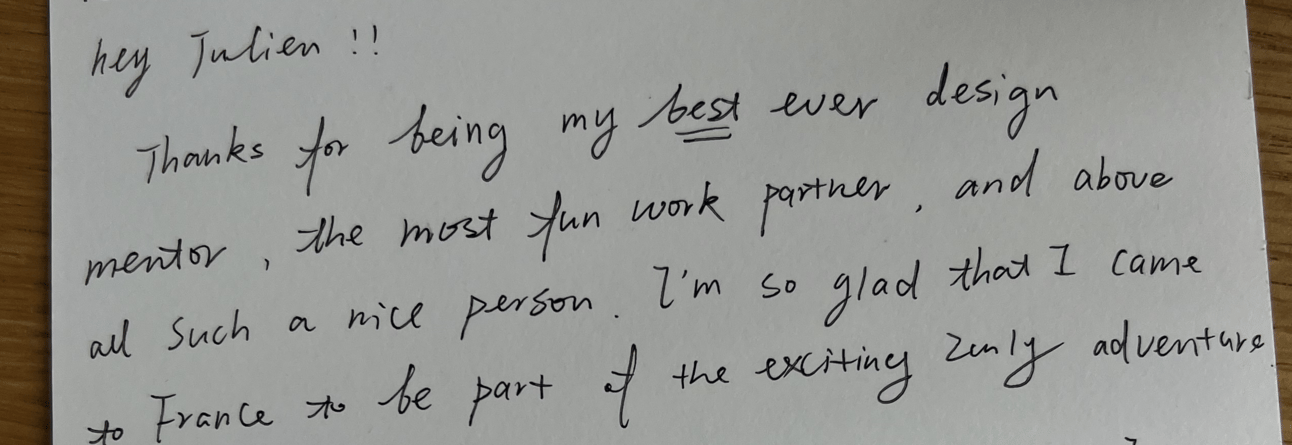
You’ll know you’ve done something right, for yourself, your company, and your teammates, when, years later, you get notes like this one:
Julien.