


I’ve been obsessed with the notion of timing and paradox for as long as I’ve been designing.
My experience working in restaurants has lasted nearly as long as my career in tech, and the nonlinear paths offered by the latter have always fascinated me.
This issue is an attempt to put into words something that’s been on my mind for a while.

Just like the endless debate between remote and on-site work, freelancing versus joining a company full-time is a nuanced topic.
Over the last 17 years, I’ve split my time exactly 50/50 between freelance and full-time roles.
I don’t pretend to have a definitive answer and this is not a guide by any mean, but I’ve gathered some insights and common misconceptions that might help you navigate your own decisions in your career.
Whether you’re a seasoned designer, an engineer, or a junior starting out, I hope you’ll find something valuable here.
Let’s cut through the clichés straight up.
There’s a lot of romance and idealization around freelancing. But freelance isn’t the freedom you think it is.
I mean, sure there is relative freedom by picking the projects you want to work on, the companies you want to work with, and the spots you want to work at.
But that freedom lasts only as long as you can afford to say no. And few freelancers actually can.
Should I accept this gig for two months?
Or should I just join Cool Company® instead?
Can I drop this trendy client and finally build that app I keep dreaming about?
All legitimate questions, but they slowly become relentless background noise.
Say goodbye to uninterrupted creative flow.
Freelancing is half design and half everything else. Admin, invoices, chasing leads, marketing, networking, client management. All seasoned generously with stress and self-doubt.
But to be honest, the toughest part of freelancing is definitely watching your long-term clients win big. Without you.
It happened four times.
I’ll dive deeper into how it feels to exit (or miss one) in a separate playbook issue, but those were four exits I watched from the bench.
Sure, my design work and expertise played a role, but seeing founders I collaborated with for months, sometimes years, achieve life-changing outcomes while I stayed on the sidelines left me with mixed feelings.
Pride first. Then frustration, and FOMO.
After a year freelancing for Zenly, Antoine and Alexis offered me a spot on the team. Timing was perfect. So was the opportunity.
Honestly, freelancing as a “trojan horse” to test a company’s vibe is smart. You get as close as possible to the company's routine and the people working there. Plus, you completely skip that early cringe phase when you first land in a new company—you know exactly what I mean.
I had a real overview for months and I knew I wanted to be there.
Joining was awesome but it also meant earning less than I did solo that same year: my total comp was 75K€ in 2016. Meanwhile, I’d cleared just over 100K€ freelancing that same year.
But here is what gets interesting: there was no equity upfront. This really wasn’t that common and automatic back then to give equity in french startups.
I fully trusted them that when the time comes—if it comes—I’d not be forgotten. Pure gut instinct of course, but also I’ve had the chance to know them for many months and knew I could actually trust them.
Six months later, Snap Inc. acquired Zenly.
This event completely changed my trajectory.
It wasn’t just about finally cashing in (though that helped). It was about depth, ownership, and compounding my career in ways freelancing never allowed.
Freelancing offers variety and virtually no routine, but full-time unlocks true depth.
Joining Zenly, and later amo, meant becoming part of a team I admired, crafting details I cared about, being listened to, and learning daily.
I was fully part of it and not a spectator.
I guess, deciding if or when to make the jump comes down to where you are in your career, and trusting yourself enough to leap.
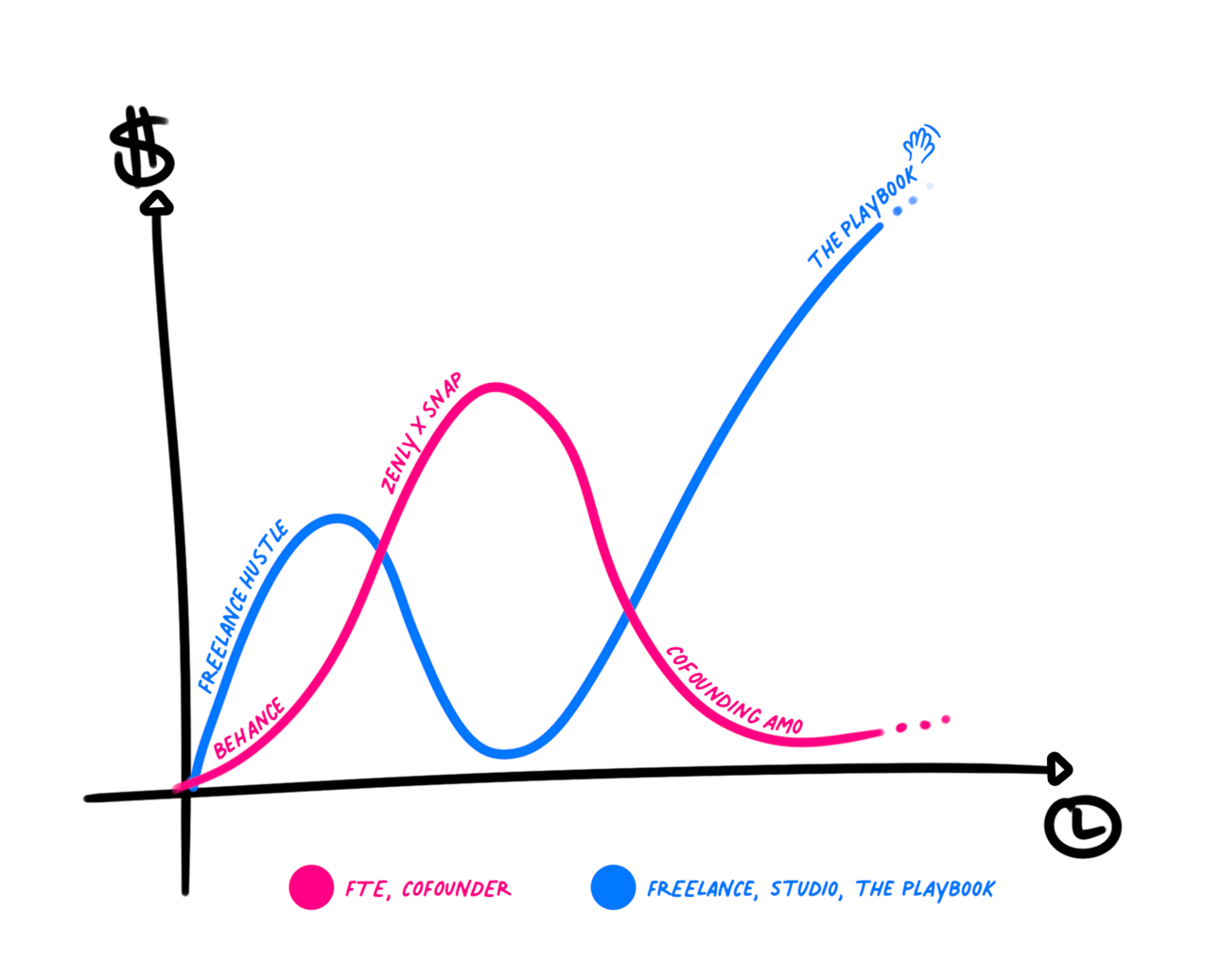
Freelancing early in your career is kind of risky. Without a network or solid reputation, you become a commodity stuck on Fiverr or Upwork, grinding for peanuts. For me, it was 99designs contests at night while still working in restaurant shifts during the day.
The hustle was real.
I think what’s truly missing when you're just getting started in your career is true mentorship and business, product thinking. And you can’t really get that when you’re freelancing.
But joining a company that early can lead to being trapped. Because you lack experiences and awareness, it’s easy to accept very bad deals when it comes to salary and stock-options.
Be mindful. Owning a piece of what you’re building is crucial, but I’ve got close friends who’ve spent over a decade in startups, holding stock options from four different companies. All worth nothing today.
Unless the company is already public, turning stock options into real cash takes awareness, trust, and (a lot of) luck. I’ll dedicate an entire issue to this soon.
In the meantime, never hesitate to ask around, ask other founders, seasoned designers and engineers, what they think of the deal.
Freelancing mid-career can be a smart move, but only if you’ve built real leverage: sharp skills, strong credibility, and a network that trusts you. You’ve ramped up and now it’s time to grow steadily.
Without leverage, you’re chasing quick cash instead of compounding your growth inside rocket-ship teams.
Mid-career is exactly when you should be provoking luck, betting on yourself, and grabbing bigger opportunities.
On another hand, freelancing in a more senior stage can be gold. If you have the reputation, skills, and contacts, you can charge premium rates, pick dream projects, and stay fresh.
But here’s the catch: at that stage, you’re flooded with tempting opportunities. Saying yes to everyone is easy. Saying no is the real skill.
Dive too fast and you might end up trapped in golden handcuffs, stuck in a high-paying gig that drains your energy, creativity, or both.
You get it. It’s never black and white.
My intimate conviction is that your career should never be linear. Especially in the tech industry.
Bet on people and timing to help you choose the right direction.
Not freelance OR full-time. But freelance AND full-time.
Forget the binary freelance vs. full-time narrative. Master the art of career timing instead.
Zenly was my right place, right time moment.
Had I stayed freelance, I’d have missed it all.
Until the next moment.
Julien.